The Good News with Manny

HOW TO GET A LINE OF CREDIT

I remember that more than 30 years ago, getting a home equity line of credit was not something mortgage brokers could easily arrange for their clients. Although banks and Savings & Loans offered certain options, but we didn’t have access to those programs.

Then I became friendly with a bank manager who allowed us to offer his bank’s line of credit to our clients. It was a big deal! Finally, we had another way to help people who needed money without refinancing their existing first mortgage.

A lot has changed since then. Today, many banks are much more selective about offering lines of credit. Some prefer to work with their existing customers, especially those who maintain substantial deposits with the bank. Fortunately, mortgage brokers now have access to different sources of financing, although qualifying depends on each client’s circumstances.

Let me give you a few examples. Recently, I closed a second mortgage for a client who was doing major remodeling on his home. He needed approximately $500,000. He had approached his bank, but the bank turned him down. After reviewing his situation, I found a different solution: a reverse mortgage second. The lender offered him $600,000. I suggested that he consider taking the larger amount because, when you are doing construction, you never know what unexpected expenses may come up. Of course, the additional borrowing also has costs that need to be considered. We closed the loan.

Then I had another client who was going through a divorce. She wanted to keep her home but needed money to pay her husband his share of the equity. Once again, I was able to arrange a reverse mortgage second.

Reverse mortgages can be very helpful, but they are not for everyone. Right now, I am working with another client who needs a relatively small amount of money to finish one of his projects. He already has a first mortgage with a very low interest rate, and he doesn’t want to lose it. That makes sense. Why refinance an entire mortgage at a higher interest rate when you only need additional money? But there is a problem. His income is not sufficient to qualify for a conventional line of credit under the programs we have reviewed. So, I am looking at other possibilities, including a reverse mortgage, if he qualifies. In his situation, that might mean a loan rather than a traditional line of credit.

Another client wants to buy a business. Not a building. A business. She needs money for the purchase, and she has substantial equity in her home. I am exploring a loan program that may allow her to borrow against that equity without relying entirely on conventional income qualification. Again, a different situation requiring a different solution.

I regularly receive information about new home equity loans and lines of credit. Some of the offers look very attractive. But there is a difference between receiving an offer and qualifying for the loan. For a conventional line of credit, the lender generally has to consider your existing mortgage payment, property taxes, insurance, car payments, credit card obligations, and other debts. Then we add the payment on the proposed new loan. All of this has to be compared with your qualifying income. And that is where many borrowers run into problems. They may have substantial equity in their homes and excellent credit, but their reported income is not enough to qualify. That doesn’t necessarily mean there is no solution. It means we have to look at other options.

Sometimes it is a conventional home equity line of credit. Sometimes it is a fixed-rate second mortgage. Sometimes it is a reverse mortgage. And sometimes it is a specialized loan program that looks at the borrower’s financial situation differently. Every case is different.

After more than 40 years in the mortgage business, I have learned that the important question is not simply, “Can I get a line of credit?” The better question is: “What is the best way to get the money I need without disturbing the mortgage I already have?” That is where experience and knowing the available programs can make a difference.

So, if you have a good first mortgage with a low interest rate and need some additional money, give me a call. I might be able to help you find a solution.

Thank you!

Manny Kagan
Mortgage Broker | 40+ Years of Experience
(415) 225-7920

The Good News with Manny

DOWNSIZING WITHOUT MONTHLY PAYMENTS: THE POWER OF REVERSE MORTGAGE


About 10 years ago, a couple came to my office. He was 82, she was 73. They were renting—and suddenly, the home they lived in was put up for sale. They faced a harsh reality:

  • Limited income
  • Savings, but not enough to sustain long-term rent
  • No ability to qualify for a traditional mortgage
  • And no capacity to make monthly payments

They were at risk of losing stability.

THE SOLUTION: BUY INSTEAD OF RENT

Instead of continuing to rent, we structured a plan to help them own their home—with no monthly mortgage payments:

  • Purchase price: $375,000 (in Pittsburgh)
  • Down payment: from their savings
  • Loan: $220,000 through a Reverse Mortgage
  • No required monthly mortgage payments
  • Full homeownership
  • Financial stability

WHAT HAPPENED NEXT

Years later:

  • We refinanced the reverse mortgage
  • Eventually, they paid off the loan
  • They preserved more equity for their grandson

This is what I call “right-sizing with dignity.”

HOW REVERSE MORTGAGE HELPS WITH DOWNSIZING

Today, I’ve helped many clients use this same strategy.

Scenario 1: Selling a Larger Home → Buying a Smaller One

  • Sell existing home
  • Use part of the proceeds as a down payment
  • Use a Reverse Mortgage (HECM for Purchase) for the rest

Result:

  • No monthly mortgage payments
  • Easier qualification (no income stress)
  • More cash left over for retirement

Scenario 2: Creating a Retirement Safety Net

Some clients:

  • Buy a home with the proceeds from the sale
  • Set up Revers Mortgage  line of credit

This line of credit:

  • Acts like a growing reserve fund
  • Increases over time if unused
  • Provides security for future needs

WHY THIS STRATEGY WORKS

  • Eliminates monthly mortgage payment
  • Preserves cash and liquidity
  • Allows clients to qualify without strong income
  • Turns home equity into a retirement asset
  • Supports what I call Comfortable Aging™

THE BIGGER IDEA

This isn’t just about mortgages. It’s about:

  • Staying independent
  • Living with dignity
  • Reducing financial stress
  • Making your equity work for you

If you—or someone you know—is:

  • Downsizing
  • Struggling with income qualification
  • Looking for financial peace in retirement –

LET’S HAVE A CONVERSATION—YOUR HOME EQUITY MAY BE THE SOLUTION.

Manny Kagan,
Your professional mortgage broker since 1983

Fridays with Manny

image

HOW TO FIX A CAR

In 1969, at 22, I was an engineer in Riga, Latvia, working for a company with military contracts. When my wife decided to immigrate to Israel — one of the early pioneers — it became difficult for me to get permission to leave, while working there.

So, I became a mechanic.

Our neighbor owned a truck garage. I had never fixed cars before, but I had worked as a toolmaker in my teens, so I was comfortable with tools. I worked mostly on wheels, breaks and worn parts — not under the hood — learning as I went. Still, “car mechanic” was never truly my profession.

Now when something happens to my car, even to change flat tire, I call AAA insurance.

Recently, when the digital screen in my Audi stopped working, I took it to the shop. After much investigation, the solution was simple: a hidden reset button. One press — and it worked.

That’s how much of a mechanic I am today.

With modern cars, sometimes even specialists just press buttons and hope. Maybe life is like that too — sometimes all we need is a small reset. And in the meantime, we can still admire beautiful machines — like the three stunning cars I photographed in Los Angeles.

Enjoy and share with your friends!

image


Fridays with Manny

image

THE HISTORY LESSON 

July 4, 2026 will mark 250 years since the founding of the United States. When we think about 250 years, it feels like a long time — yet in the scope of history, it is just a moment. How about 2,500 years ago, when the mighty Babylonian Empire destroyed the First Temple in Jerusalem and exiled the Israelites to Babylon?

From that exile comes the story of Purim. In the Persian Empire, a royal adviser named Haman plotted to destroy the Jewish people because of his hatred toward Mordechai. The story, told in the Book of Esther, describes how that decree was overturned and the Jewish people survived. The holiday of Purim, which this year starts on the evening of Monday, March 3rd, celebrated that reversal — when a plan for destruction turned into deliverance.

Two thousand years ago, the Roman Empire destroyed Jerusalem and the second temple in the year 70 CE. Later, the Ottoman Empire ruled much of the Middle East, including the Land of Israel, for 500 years. To be followed by the British Empire once governed vast territories around the globe.

Empires rise. Empires fall.

Yet the Jewish people, though small in number, endured through Babylon, Persia, Rome, the Ottomans, and beyond. Today, the modern State of Israel exists as a sovereign nation — something that would have seemed unimaginable during many periods of exile.

So, what is the lesson?

History teaches humility. Power is temporary. Hatred destroys the hater more than the hated. And attempts to eliminate a people have never erased them from history — but they have erased the empires that tried. Purim is not only a Jewish story; it is a reminder that cruelty and domination are never lasting foundations for greatness. Endurance, identity, faith, and moral courage — those are what survive time.

As America celebrates 250 years, perhaps the deeper question is not only how powerful a nation becomes, but what values it chooses to stand for — because history always renders its verdict.

Holidays are usually decorated with the bouquets of flowers. Please accept my contribution.

Happy Purim!

image


The Good News with Manny

TO BUILD OR NOT TO BUILD?

That’s a question I hear a lot. Last week we had a presentation from one of our lenders about construction loans, and I want to share a few key takeaways with you.

When someone wants to build a new home—whether they’re buying a lot, tearing down an existing home, or starting from scratch—there are usually three major components involved.

  • First, the land. If you don’t already own it, land loans typically require around 50% down.
  • Second, the design phase. You’ll need an architect and an engineer, which means upfront costs.
  • Third, permits. These also cost money—and time.

Once those pieces are in place (or sometimes while they’re in progress), the next step is securing a construction loan. This loan has two parts:

  • the construction phase, and
  • the take-out loan, which pays off the construction loan once the home is complete.

Traditionally, when clients asked me about construction financing, I had to qualify them based on their income for the future take-out loan—and that could be challenging for some borrowers. But here’s the good news.

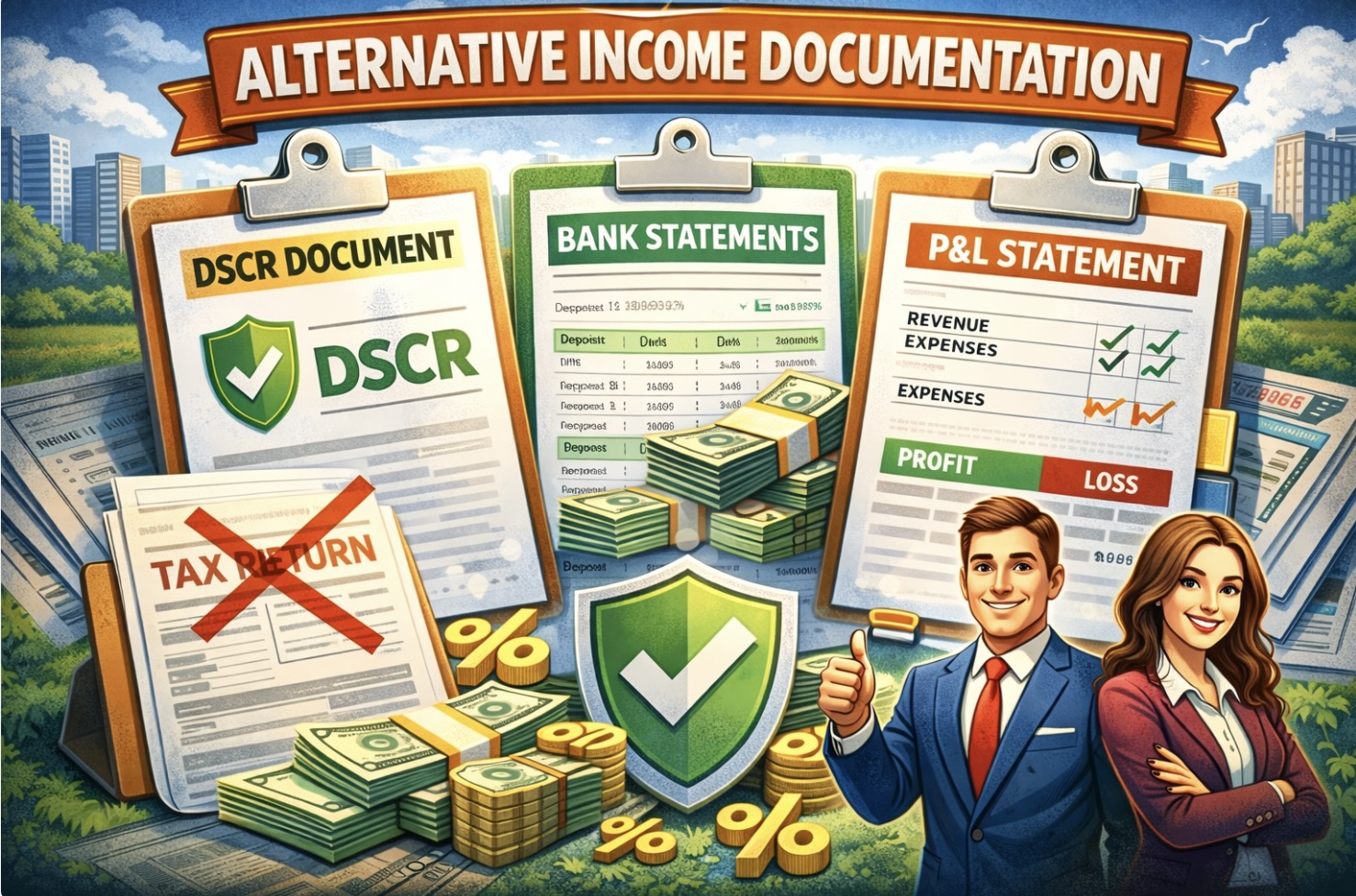
In this recent presentation, the lender explained that they can now qualify borrowers using alternative income documentation, such as:

  • DSCR,
  • bank statements,
  • or profit and loss statements.

That opens the door for people who may not show enough income on tax returns but are otherwise very strong borrowers.

If this raises questions for you—or if you’re thinking about building and want to explore your options—give me a call: 415-225-7920. I will be happy to help.

Best wishes,

Manny Kagan,
President,
Pacific Bay Financial Corporation
Your professional mortgage broker since 1983


The Good News with Manny

Flexible Mortgage Solutions™

I’ve recently received a phone call from one of my former clients. I spoke with her over a year ago. She needed money, but I could not help her then because of her credit cards’ debts was too high. We agreed that she would call me back after paying them off with her next commission income. This time, she wanted to refinance her private money second mortgage which she used to pay off credit cards and had an interest rate of 14%. After running her numbers, the result was that I could get her a second mortgage with the rate 9.9% and enough money to pay off her second loan, plus get the extra amount she requested.

However, when I told her that this is going to be a Reverse Mortgage Second, she became very upset. “I am not interested in a Reverse Mortgage. I do not want for the bank to take my home away.” Despite my explanation that this is not true and that banks do not take properties away unless taxes and insurance are not paid and that she has a choice to make monthly payments, she said that she did not want anything to do with the reverse mortgage.

This was not the first time I heard comments about losing one’s house to the bank. I have no idea from where these rumors came from; nevertheless, I decided to come up with a new name. There is a Chinese and Jewish tradition that changing the name changes luck. The new name I came up with is “Flexible Mortgage Solutions™” or FMS.

To benefit from FMS, the homeowner needs to be at least 55 and to have limited income. Property can be inherited, or be part of the divorce.

Flexible mortgages offer many optional solutions. The most important is that the borrowers have the options to choose whether to make full or partial mortgage payments, or not to make any payments until they sell their property or die. In that case, the heirs will have either to keep the property or sell it, paying off accumulated mortgage balance, which is similar to a conventional mortgage.

Tomorrow, I am going to start posting a series of short videos on my YouTube Channel answering your questions about FMS/Reverse Mortgages. You will be receiving alerts from me in your email.
Hope, this will help you and your friends.

Please click on this link to watch my brief announcement.

Stay tuned and share with a friend!

Manny Kagan,
President,
Pacific Bay Financial Corporation

(415) 225-7920; || mannykagan@comcast.net

NMLS #205637
DRE #00824602

The Good News with Manny

HOW TO BENEFIT FROM HOME’S EQUITY

During Corona pandemic, when many businesses suffered, mortgage industry, as well as the real estate, was booming. The interest rates were historically low and everyone could get rates around 3%-4%. As it often happens, the pendulum moved into opposite direction and in spite of the speculation, no one really knows when the interest rates will start going down again.

Meanwhile people continued to spend money on their credit cards which have very high interest rates and had other needs for money. And since values of properties continued to go up and no one wanted to lose low rates, there is the proliferation of the lines of credit (L/C) and second mortgages. In the past, the source of these products were major commercial banks. However, some of them stopped offering L/C, while others became very conservative and limited loan to value (LTV).

As a response to the need, the Wall Street investors through mortgage bankers used the opportunity and started to offer L/C up to 90 percent LTV. Even for the self-employees – by using their business cash flow as the source of income. Some lenders offer L/C for the rental properties. And then for the borrowers at the advanced age who cannot get conventional 2nd mortgages, there are Reverse Mortgage Seconds.

During our recent staff meeting, we discussed some of the opportunities with Debra Kidder Steere from Newfi Wholesale. Follow this link to watch a piece of our conversation posted this morning onto my YouTube channel.

Always feel free to contact me on the phone or by email as showing below.

I promise to help!

Manny Kagan,
President,
Pacific Bay Financial Corporation

(415) 225-7920;  ||  mannykagan@comcast.net

NMLS #205637
DRE #00824602

The Good News with Manny

How to Buy Your First Home
with 1% Down Payment

I remember how in April 1984 (forty years ago) we bought our first home for $224,000. Since I just started in the mortgage business six months prior, we were not qualified to get conventional mortgage. We just had $10,000 for the down payment. The seller agreed to carry her loan with interest of 12% for a year, but I needed to get another $30,000 which I borrowed from friends and clients to whom I paid 15%. A year later, we refinanced the loan with World Savings at 9%. Many things have changed since then. We still live in the house.

Today prices are higher, so are salaries. Thanks to a number of creative programs, people can buy their first house or condo for about $790,000 with 1% down payment and 2% second mortgage forgivable after three years and no mortgage insurance. The Program has income limitations, depending on the property location. The total amount which includes down payment, reserves, closing costs and our 1.5% compensation is approximately $30,000. This amount can be a gift from parents or siblings.

Here is a video fragment of the recorded presentation by Brett Scott from WaFd Bank that he delivered during our recent staff meeting.  Our faces occasionally show up in the upper right-hand corner of the screen. Follow this link for more information.

Feel free to contact me on the phone or by email as showing below.

I promise to help!

Manny Kagan,
President,
Pacific Bay Financial Corporation

(415) 225-7920;  ||  mannykagan@comcast.net

NMLS #205637
DRE #00824602

The Good News with Manny

New Learning Opportunities
Have Arrived!

About 18 months ago, I started a project called Money Solutions Academy (MSA) as an educational video series on YouTube. Until today, those videos were primarily targeting the real estate agents community, for whom I wanted to open more opportunities to reach out to more clients – with creative mortgage solutions.

As I was progressing through, the idea to expand this information to the mortgage brokers community was growing in my mind. Though I’ve been a mortgage broker for over forty years, there are not many young people who have joined our industry. Therefore, I was very pleased when Iryna Haras called me and asked me to teach her how to become a mortgage broker.

In the past I had a course where I taught many students some of whom still make a good living in the mortgage business. This time I decided to simplify the process and to use my time more productively. We are going to work on the real cases of my clients and teach through the experience, which we will be recording and showing through MSA (aka Mortgage Solutions Academy) on YouTube.  I also decided to write a new book as a companion to the course – “Mortgage Solutions for Smart People™. How to Connect 5 P’s.”  

5 P’s = People + Property + Product + Players + Process


The first post in the new series of my videos is about mortgages for the condominiums and about the differences between Warrantable and Non-Warrantable condos, and how this affects the final result in getting and qualifying for the mortgage.

So, please click on this link to watch, enjoy and share this video.

Manny Kagan,
President,
Pacific Bay Financial Corporation

NMLS #205637
DRE #00824602


The Good News with Manny

Every Borrower is Unique

Lately, we have been reading and hearing a lot about Artificial Intelligence. Some claim that it will replace many occupations, like attorneys. How about real estate agents and mortgage brokers? Everything is possible, but not so soon. Of course, if it involves identical properties (like in the subdivisions) and identical borrowers. However, in my over forty years as a mortgage broker I did not meet one yet. Everyone is unique.

Recently, I have received a call from the real estate agent whose father wanted to help her and her brother to buy two-unit building. After running her father’s credit report, I saw that he was not big help, since, as a result of high debts, his credit score was low. Since she was a self-employed, we had to wait two years to be able to use her income. She had sales and earned commission in 2023, however, her last two years income averagely was not significant. Her husband’s salary was $80,000 a year. Her father-in-law was considering to get in the game as well and had money for the down payment, but changed his mind. Brother and his wife had good income, but no money for the down payment.

Possible solution was to refinance condominium owned by mother and to pull out cash, which is going to be a gift. Only after I receive information from everyone and order credit reports, I will be able to calculate how much of the property (preferably two units with an in-law) they can buy. After that I will issue pre-approval letter, and my client will be able to make offers and pray for the acceptance. As you can see, there are no simple cases.

Click on this link to listen to my thoughts about artificial intelligence in a video that I recorded and uploaded for you onto my YouTube channel.

In the meantime, feel free to call me whenever you come across a potential client. And I promise to help.

image